Big Street Guns Posts

29/03/2016 / / Nikon V1

Memory cards are not one of those photography related devices that make photographers excited. You probably never heard a photographer say “wow, that new SD card is so cool, I’ve got to buy one!” Nevertheless memory cards can impact user experience dramatically, especially if you are shooting a lot in burst mode, recording high definition or 4k video with high bit rates or if you have a habit of filling the memory card before transferring all of your images and video files to your computer in one go. This is where the read and, even more importantly, write speeds of the memory card make themselves noticeable. If the memory card is too slow at writing data, the buffer of your camera will fill up rather quickly or you won’t be able to shoot video with high bit rates at all. If the read speed is too low, on the other hand, transferring data from the card to the PC will take quite a long time.

DSC_8702

In this blog post I would like to show you some benchmarks and talk a little about my newest SD card, the Transcend Ultimate Speed SDHC Class 10 UHS-1 32GB. Quite a mouthful, isn’t it? In a later post I’m going to decipher the “marketing speak” for you and do a comparison with some of my older memory cards. What you will see is that speeds indicated by manufacturers can be very optimistic or downright misleading. For now, let’s take a look at two very popular benchmarks – CrystalDiskMark and AS SSD – used to test various storage devices (HDDs, SSDs, memory cards, USB sticks, etc.):

09/06/2014 / / C-Mount 25mm f/1.4

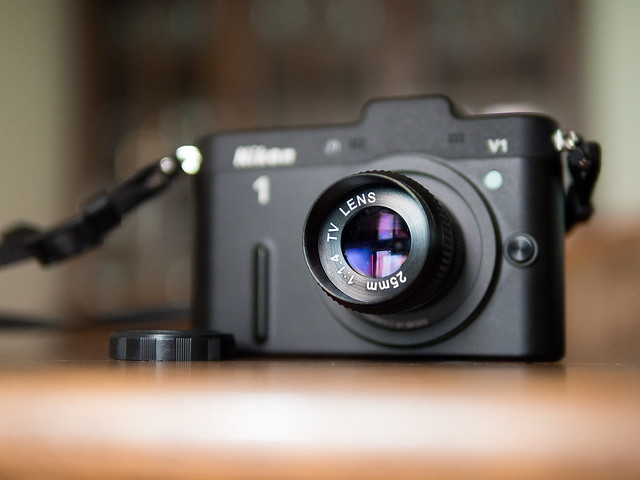
I’ve bought the 25mm f/1.4 C-Mount lens last August with its larger sibling, the 50mm f/1.4 C-Mount, which I’ve reviewed here. This is a new record even for me in regard to long term usage of a lens, before writing a review. It took me four months to review the 50/1.4 C-Mount and a whopping eight to do a review of the Nikon 1 Nikkor 18.5mm f/1.8. Despite having the 25/1.4 and using it for such a long time, I don’t have that many photos to show for it. One reason is that it is a specialized lens, which I only use when I feel that its characteristic look adds something to the photo opportunity at hand. Otherwise I go with the 18.5mm f/1.8, which is similar in terms of focal length and DOF control, and doesn’t have the swirly bokeh I don’t like that much. The other reason is that I have the afore-mentioned 50/1.4 C-Mount. Unlike the 25/1.4 it cannot be substituted with the 18.5mm, because it is an entirely different beast in regard to focal length and bokeh. Having smoother focus and aperture rings, whereby the former is further away from the body (25/1.4’s focus ring is next to the body), makes it easier to use. I will go into more detail on that later. This is what the 25/1.4 C-Mount lens looks like mounted on the Nikon V1 and in the hand.

Nikon V1 & C-Mount 25mm f/1.4

05/06/2014 / / C-Mount 25mm f/1.4

Unlike with my previous photos I’ve developed the photos you see below in Lightroom 5.4 and used the fringing and CA tools to reduce color artefacts on edges with strong contrast. Not that it did much good, considering just how flawed the 25mm f/1.4 C-Mount lens is in this regard. 😉 You can find my previous posts about the C-Mount lens here. I will be posting the review of the lens tomorrow. In the meanwhile you can view all my photos taken with the 25/1.4 C-Mount in my Flickr set.

Nikon V1 & C-Mount 25mm f/1.4

26/05/2014 / / C-Mount 25mm f/1.4

After a pause lasting two months, over the course of which I’ve been shooting with my Micro Four Thirds gear, I took the Nikon V1 with the 25mm f/1.4 C-Mount lens for a spin. Unlike the 50mm f/1.4 C-Mount, the 25/1.4 is not a lens I enjoy shooting a lot, which is why I still haven’t gotten to writing a review. I simply haven’t taken enough photos with it to be confident enough to pass a final verdict. I hope that it won’t take 8 months, like it did with the 18.5mm f/1.8, until I’m ready to sit down and write a proper review. Btw. you can read my long term review of the 18.5mm here.

Nikon V1 & C-Mount 25mm f/1.4

17/05/2014 / / Nikon 1

Since I posted my first batch of photos taken with the brand new Olympus OM-D EM-10, I’ve had more time to study the camera and to take some additional photos. I must say, as much as I enjoy having the IBIS and the flexibility which the larger m4/3 sensor and the Panasonic Leica 25mm f/1.4 and Olympus 45mm f/1.8 provide in terms of low light performance and DOF control, almost equally I hate the color rendition, seemingly random auto white balance and “dark” metering of the E-M10. The Nikon V1 with the Nikkor 18.5mm f/1.8 (you can read my review of the lens here) still have some advantages which make the setup very fun to use. For example, the V1 has extremely precise metering and Auto WB, vastly superior to the both systems the E-M10 employs. I find that with the latter I’m constantly correcting exposure by +0.3-0.7 stops to get the result I’m used to with the V1. And even then, some work in Lightroom is needed to make the highlights “roll off” as smoothly as with the V1. The reason for this is no doubt the fact that the E-M10, while having greater dynamic range overall, has less highlight headroom and a steeper curve in the highlight region (but more shadow headroom) than the V1, thus underexposing constantly to protect those highlights.

Olympus OM-D E-M10 & Panasonic Leica 25mm f/1.4

14/05/2014 / / Nikon 1

After releasing the Nikon 1 J4, WP-N3 waterproof case and SB-N10 underwater flash last month in Europe and Asia, Nikon is now making these products available in the USA as well. This is a particularly interesting move, considering that some recent rumors have suggested that because of poor sales Nikon will not be releasing the J4 in US. The price of the camera with the kit zoom will be $596.95/£499.99/€549. Read on for pre-order options and additional information on the WP-N3 underwater case and SB-N10 underwater speedlight:

Nikon-1-J4-mirrorless-camera-black

14/05/2014 / / Nikon 1

Nikon-1-S2-camera-blackToday Nikon has announced the successor to last year’s lowest-end S1 mirrorless camera, the Nikon 1 S2. It will feature the same 14MP sensor as the V2 and J3 and the same processor as the V3 and J4, allowing for 20fps burst shooting and 1080p 60fps video. Unlike the J4 it lacks a touchscreen and 720p@120fps slow-mo. For more detailed analysis of the S2’s feature set, head over to imaging-resource.com. Nikon’s official info:

13/05/2014 / / Nikon 1

Nikon-1-mirrorless-camerasToday Nikon has released new firmwares for all of its Nikon 1 mirrorless cameras. Besides some minor bug fixes support for the FULL/LIMIT focus limit switch on the 1 NIKKOR VR 70-300mm f/4.5-5.6 has been added and in the case of the AW1 an underwater option for the underwater Speedlight SB-N10 has been added. To read the change logs and download the firmware updates, follow the links below:

06/05/2014 / / Nikon 1

Sufficient time since the release of the Nikon 1 V3 has passed and there are now enough reviews, samples and videos to make one’s mind about the camera. I’ve added all the worthwhile material to the link collection you see below. Hope that helps you reach a decision whether to upgrade, switch to a new system or stick to your V1/V2 and wait for the eventual V4. 😉 Nikon_1_V3_10_30_PD_DFN1000_GRN1010_angle

03/05/2014 / / Olympus 45mm f/1.8

I’ve had my Olympus OM-D E-M10 for two weeks now, but due to being swamped at work and having some business meetings abroad I couldn’t find the time to write a blog post about the camera and the first batch of pictures I took with it. Together with the E-M10 I also bought the Olympus 45mm f/1.8 and the Panasonic Leica 25mm f/1.4. Both seem to be excellent lenses. I can’t say much without some thorough testing first and I don’t like to go out on a limb, but Olympus cameras seem to be like mini super computers with loads of customization, which can be overwhelming at first. But once you assign the functions you want to the Fn buttons and customize the features and the way the camera operates to your liking, chances are you won’t need to dive in to a menu for a looong time. The E-M10 is the opposite of the Nikon V1. You can customize almost anything and the level of manual control is insane, but in a good way. The aspect of the camera I like best is undoubtedly the IBIS. With the V1 I’ve learned to hold the camera firmly and to do my best to avoid any movement. I even hold my breath when going under 1/50th of a second, but with the Olympus I find myself shooting anyway I see fit, while still getting sharp photos free of camera shake. Anyway here are some of my first photos with the E-M10, 45/1.8 and 25/1.4, most of which were taken at high ISO (ISO1600 and above).

Olympus OM-D E-M10 & Olympus 45mm f/1.8